
The Palestinian side is said to have committed to check operations against Israeli targets and Jerusalem in turn would put a halt to all military actions as long as the Palestinian commitment held.

The operation in Nagaland and Manipur was carried out after the army received "credible and specific" intelligence.

The new data comes a day after China and the US signed a long-awaited phase one deal, marking a ceasefire in the 18-month-long trade war which saw the world's two largest economies slap 25 per cent tariffs on about half a trillion-dollar worth of each other's exports. The world's second-largest economy grew by 6.1 per cent last year, its worst performance since 1990, but it remained above the psychologically important mark of six per cent, according to the National Bureau of Statistics (NBS).
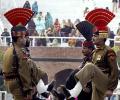
In their first meeting after the Kargil war, the Indian Director Generals of Military Operations will on Tuesday cross over to the Pakistani side of the Wagah border to meet his counterpart to discuss ways of ensuring ceasefire on the LoC and is expected to register his protest over the cross-border raids.

From Sri Lanka's most popular political family to its most despised -- going by the voices on the streets calling for the Rajapaksas' ouster -- what went wrong for the clan? Veteran Sri Lanka watcher N Sathiya Moorthy offers an insight.
While the US stayed away, the remaining 14 members voted in favour of the resolution which came after three days of intensive negotiations.
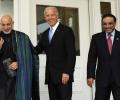
US-Pakistan relations are poised to touch a qualitatively new level under the Biden administration, notes Ambassador M K Bhadrakumar.
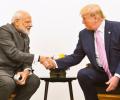
'From the Indian perspective, Trump's invitation to Imran Khan to visit the White House is a bitter pill to swallow,' points out Ambassador M K Bhadrakumar.

Trump disclosed that he was to meet the Afghan President and senior Taliban leaders on Sunday at his Camp David retreat.

Rejecting Pakistan Prime Minister Nawaz Sharif's demand for United States intervention in resolving the Kashmir issue, External Affairs Minister Salman Khurshid on Sunday said India will not accept this as the matter is a bilateral one agreed to between the two nations.

The five-nation grouping BRICS on Tuesday resolved to combat terrorism in all its forms and manifestations, including the cross-border movement of terrorists, and vowed to step up joint efforts in building support for an India-backed global framework to effectively deal with the menace.

The decision has been taken due to increasing civilian casualties as two women were killed and seven other civilians injured in alleged firing by Indian troops on Tuesday.

'If the situation escalates, then mini-scale firing might happen.'

As neighbouring states of Nagaland await clarity on the Naga peace accord, Assam Chief Minister Tarun Gogoi has said any move that affects the interests of his state will be opposed "tooth and nail".
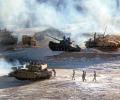
'The Chinese are only about 160-170 km behind.' 'It will not take much time for them to bring their troops back, considering that they have better infrastructure -- and the weather is now favourable.' 'They can move in much faster as the terrain favours them.'
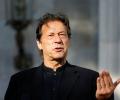
Pakistan Prime Minister Imran Khan on Wednesday said India will be benefitted economically by having peace with his country as it will enable New Delhi to directly access the resource-rich Central Asia region through Pakistani territory.

Fear and uncertainty have returned to haunt the residents in areas along the Indo-Pak border in Jammu and Kashmir, where heavy mortar shelling by Pakistan Rangers has triggered migration.

Pakistan on Thursday described Indian Army chief Gen Bikram Singh's remarks about retaliating against any possible ceasefire violations on the LoC as "provocative and unfortunate".
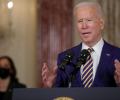
In his maiden address to the employees of the State Department, the US president said he has come to the building to send a clear message to the world: America is back. America is back. Diplomacy is back.

It is time we pre-empt Pakistan and the separatists by fast tracking normalcy, advises Colonel Anil A Athale (retd).

'Pakistan has worsted India in the Afghan proxy war and the defeat becomes a template of regional politics,' points out Ambassador M K Bhadrakumar.

'Under National Security Advisor Ajit Kumar Doval and now Chief of Defence Staff General Bipin Rawat, India began to actively work on Pakistani internal faultlines with a possibility of the break-up of Pakistan as the only solution,' observes Colonel Anil A Athale (retd).

Hitting out at the Congress and Nationalist Congress Party, he said, they were "shamelessly" opposing the abrogation of Article 370.

'India would not like to see Pakistani domination and tutelage of Afghanistan against Indian security and economic interests.'
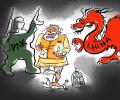
'China need not worry about a truly 'resurgent India'.' 'It's not going to happen.'

Although Suu Kyi has won an overwhelming victory, it is not going to be easy to translate this victory into political gains.

Indirect talks between Israeli and Palestinian negotiators began in Cairo on Monday to find a long-term solution to the conflict in Gaza that has killed over 2,000 people as an Egyptian-brokered 72-hour ceasefire took hold in the Hamas-ruled territory.

Congress spokesperson Manish Tewari said Saturday's incident along the LoC was an outcome of Prime Minister Narendra Modi's "flip-flops and somersaults" on Pakistan.
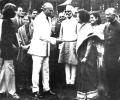
'Indira Gandhi, it appears, did not to consult her Cabinet colleagues, or diplomats, or civil servants when she decided to sign the agreement in Shimla.' 'We ruefully recall Bhutto's perfidy and the Indian prime minister's gullibility,' says Lieutenant General Ashok Joshi (retd).
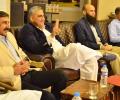
'Over the last year, Bajwa has created the environment to support bold moves on India. The ball is in India's court,' a senior Pakistan military officer tells Ajai Shukla.
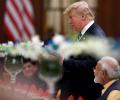
Modi may take satisfaction from his display of considerable political skill in managing a mercurial, temperamental and unpredictable US president and nudging him into uncharacteristic restraint and even carefully orchestrated remarks. This personal chemistry will come in handy if Trump returns as president in the November elections, says former foreign secretary Shyam Saran.
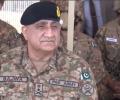
'The picture only looks worse from where Bajwa sits.' 'He sees a domineering India to the east, an unravelling Afghanistan and a complex Iran to the west, an overbearing China on the north and a US which is no longer an ally,' observes Shekhar Gupta.

A ceasefire deal has been struck between the pro-Syrian government forces and the rebels for them and the civilians still living there to evacuate the city safely.

Describing Pakistan's North Western Frontier Province area as the "fountainhead" of terror activities in the region, India on Thursday said use of terrorism as state policy with deep roots in military establishment there is a major obstacle for peaceful bilateral ties.

Pak seeks US help to ease tensions with India.

Pakistan will release 367 Indian prisoners next week to send a positive message to its neighbour amid high tension due to firing on the Line of Control, Pakistani sources said on Saturday.

South Korean President's office says Kim promised to close N Korea's nuclear test site next month.

'How can Kashmir be demilitarised if the terrorist threat remains and Pakistan continues to incite elements in Kashmir to keep the internal situation unstable?' asks former foreign secretary Kanwal Sibal.

In a turnaround, Pakistan asked for "more evidence and information" from India on the Mumbai attack case and asserted that talks cannot take place without Kashmir being on the agenda, barely three days after the two countries agreed to re-engage.

In his last column for Rediff.com, Praful Bidwai joins issues with those lauding India's covert operation against Naga rebels based in Myanmarese territory.
